Audiee.ai vs Granola
Granola is the better-looking notepad for a single meeting; Audiee.ai is the one that remembers all of them. If you want notes that turn into a searchable memory on your Mac — in English, Mandarin and Cantonese, or in Thai, Indonesian, Malay and Filipino, which Granola doesn't list — pick Audiee.ai. If you want the cleanest one-meeting recap and you're happy with cloud storage, Granola is excellent.
| Audiee.ai | Granola | |
|---|---|---|
| Runs on | macOS app | macOS and Windows app |
| Where your notes live | Your Mac — plain Markdown files | Granola's cloud |
| Joins the call as a bot | No — captures from your Mac's audio | No — captures from the device |
| Languages recognized | English, Mandarin, Cantonese — mixed in one sentence — plus Vietnamese, Thai, Indonesian, Malay, Filipino | 31 languages on desktop (Vietnamese yes; no Thai, Indonesian, Malay or Filipino); one language per meeting on mobile |
| Answers questions during the call | Yes, from your own record with sources | No |
| Memory across meetings | Yes — people, projects, decisions linked | Limited — folders and search of past notes |
| Voice dictation outside meetings | Yes — tap Ctrl in any app | No |
| Share with people who don't use it | Yes — email link, read-only page | Share links to notes |
| Export | One click, Markdown | Copy or export per note |
| Entry price | Free (3 h/mo); Pro $19/mo | Free tier; paid from about $18/mo (check current pricing) |
Where Granola is better
- The note editor: Granola blends your typed notes with the transcript into one polished page, and the writing quality of its recaps is superb.
- Templates for recurring meeting types (1:1s, standups, customer calls).
- Windows support.
Where Audiee.ai is better
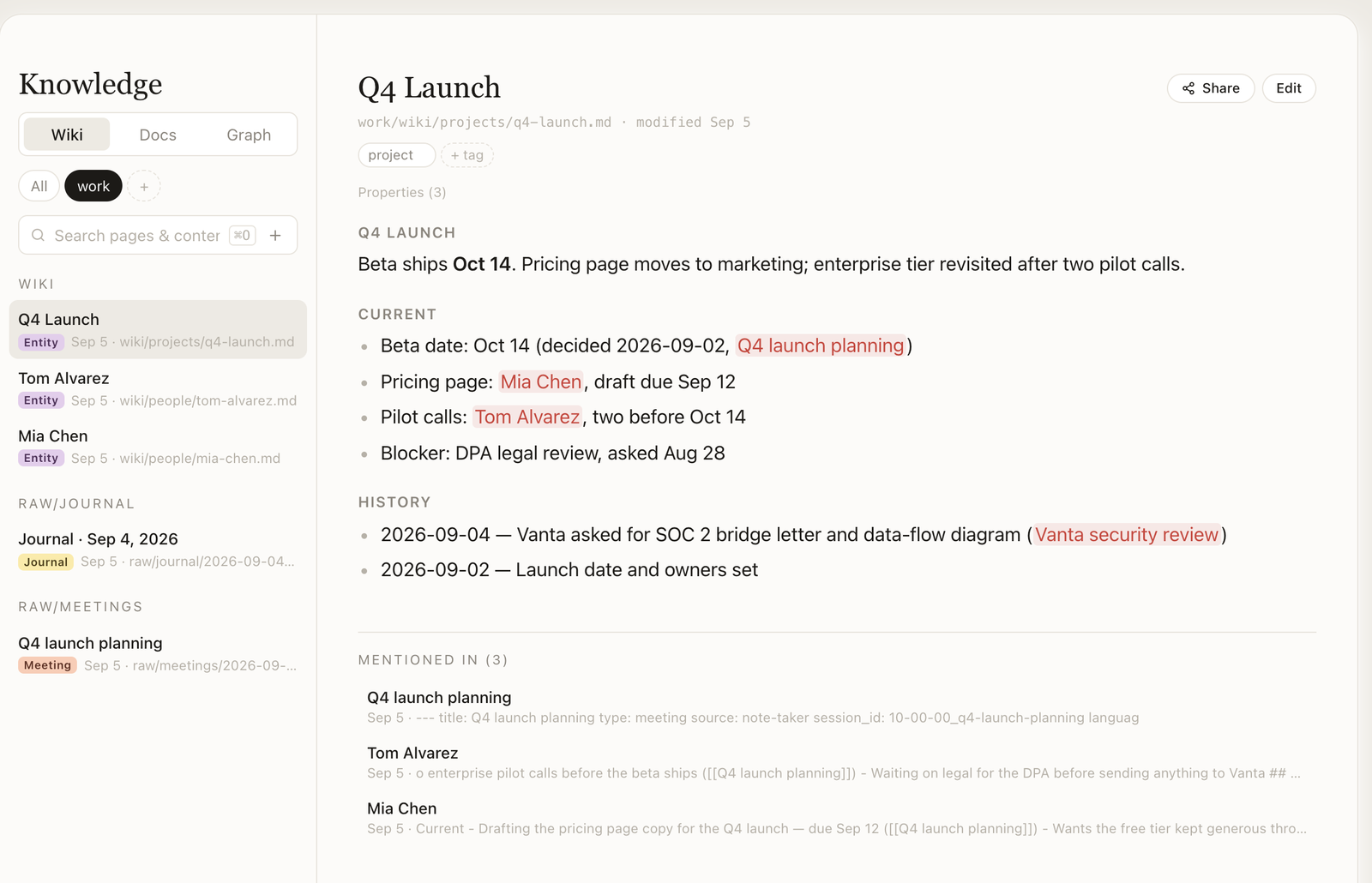
- Memory: every meeting becomes a linked page in a knowledge base you can ask questions of, with citations back to the source meeting.
- Languages: Mandarin and Cantonese recognized natively, including mid-sentence switches, plus Vietnamese, Thai, Indonesian, Malay and Filipino with English mixed in — Granola's desktop list is Western-leaning (Vietnamese is its only South-East Asian language) and its mobile app transcribes one language per meeting.
- Local-first: transcripts and notes are Markdown files on your disk, not rows in someone's database.
- The whole day, not just meetings: voice dictation in any text box, screenshots into knowledge, spoken to-dos, an evening review.
- Live help in the meeting: when someone asks a question, Audiee.ai answers from your own record.
Who should pick which
Pick Granola if you mostly need beautiful notes for individual meetings, you type notes during calls, and cloud storage is fine.
Pick Audiee.ai if you want the meetings to add up to something — a memory you can search and ask — and you work in Chinese, or anywhere in South-East Asia, as well as English.
How to try Audiee.ai next to Granola
- Download Audiee.ai and sign in — free, no card.
- Join your next Zoom, Meet or Teams call. Audiee.ai notices it and offers to take notes; nothing joins the call.
- Keep Granola running for the same call if you like. Compare the summaries, then ask Audiee.ai a question about the meeting a week later.
Common questions
Can I move from Granola to Audiee.ai?
Yes. Export your Granola notes as Markdown and drop the files into Audiee.ai's Knowledge tab (Add → file, or drag onto the list); they become searchable pages alongside new meetings.
Does Audiee.ai have Granola-style templates?
Not as a template picker. Audiee.ai's summary always includes summary, action items, waiting-on and follow-ups; you can ask for a different shape in chat afterwards.
Which one is more private?
Audiee.ai keeps transcripts and notes on your Mac and sends audio out only for transcription. Granola stores notes in its cloud. Both avoid a visible bot.
Does Granola support Thai, Indonesian, Malay or Filipino?
Not as of October 2026: Granola's desktop language list includes Vietnamese but none of the other four, and its mobile app picks one language per meeting. Audiee.ai recognizes Vietnamese, Thai, Indonesian, Malay and Filipino, with English mixed in, the same way it handles Chinese and English.