Zoom meeting notes, without a bot
Audiee takes notes on Zoom calls automatically on a Mac: it notices the Zoom window, offers to start, transcribes both sides from your Mac's audio, and writes a summary with action items when the call ends. No bot joins the meeting and nothing is uploaded except audio for transcription.
How does Audiee detect a Zoom call?
Audiee watches for the Zoom meeting window (and Google Meet, Microsoft Teams and Lark). When one appears, a small card asks whether to take notes. You can turn auto-detection off in Settings and start by hand with Ctrl+M.
How does it hear both sides without a bot?
Zoom's audio plays through your Mac; Audiee captures that output plus your microphone. That's why it needs the Screen & System Audio Recording permission — and why nobody on the call sees an extra participant.
How does it know who said what?
With the Accessibility permission, Audiee reads Zoom's active-speaker indicator and tags transcript lines with names. Settings → Meetings → Check speaker detection shows what it can see if names are missing.
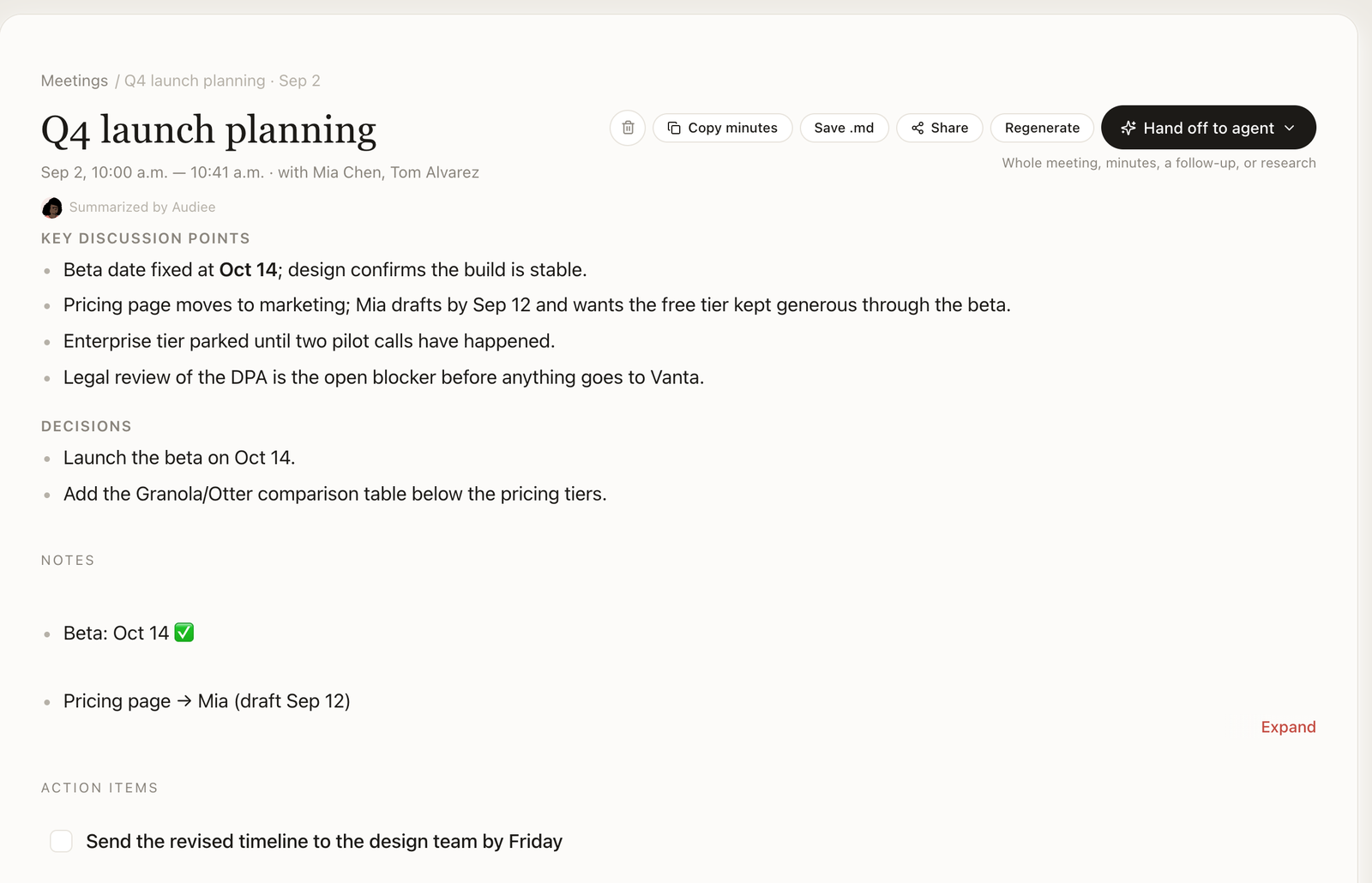
What do you get after the call?
- Summary, your action items, what you're waiting on, follow-ups.
- Commitments you made during the call, already lined up as one-click actions.
- A page in Knowledge linked to the people and projects mentioned; ask about it any time.
- Share the recap by email to people on the call — they don't need Audiee.
How is this different from Zoom's own AI Companion?
Zoom's AI Companion works inside Zoom for the host's account and keeps notes in Zoom. Audiee works for every call you're in — host or not, Zoom or not — and keeps the notes on your Mac, in English, Mandarin and Cantonese, as part of a memory that spans all your meetings.